#1 Metadiscourse as it Appears Across Disciplines
- wangmot

- Apr 23, 2019
- 2 min read
Updated: Apr 26, 2019
Introduction
The use of metadiscourse serves different functions and writers oftentimes use it to convince their audience of their viewpoints, but interpretations of texts can range widely, and the writers’ data is just one of many so readers can reject the message proposed by the writer (Ken Hyland, 1998).
One key aspect of metadiscourse is for writers to anticipate their audience rejecting their claims. They prepare for this likely occurrence by providing more support in their research with the thought that someone will oppose it. This gives it a rhetorical function in that writers have to think ahead as well as think in the way of the audience. More generally speaking, metadiscourse is a way to resolve disputes and promote allegiance (Ken Hyland, 1998). Another way writers use metadiscourse to their advantage is by writing in the style that is common in the disciplinary community they are writing to. In that way, a balance is created, and the writer is more likely to be accepted by the community.
When a writer creates a interpersonal relationship with a discourse community, he is using metadiscourse to achieve that. Hyland’s research looks at four academic disciplines: Microbiology, Marketing, Astrophysics, and Applied Linguistics, to see how metadiscourse is used in each field. Writers need to create a space so that readers can understand the community they are reading about and to achieve that, writers organize the data they present in such a way that readers will understand what is already known and what is yet to be figured out. Hyland’s research concluded that each discipline had a preferred method of metadiscourse use and that the difference in metadiscourse patterns was a good way to distinguish discourse communities.
Categories of Metadiscourse
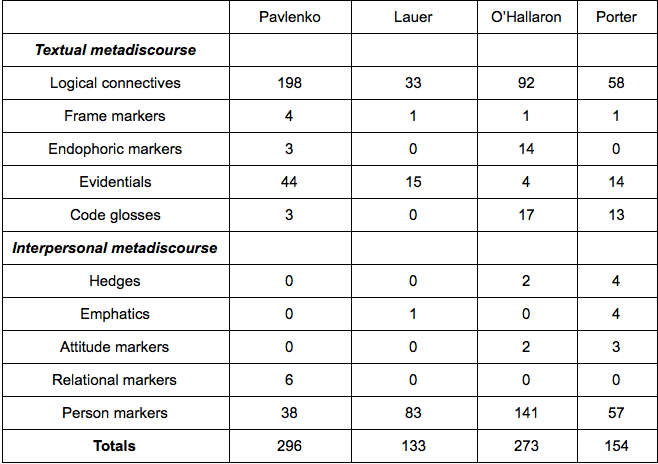
There are two main categories of metadiscourse: textual and interpersonal. The former refers to the “devices which allow the recovery of the writer’s intentions by explicitly establishing preferred interpretations of propositional meanings” (Ken Hyland, 1998). It helps interpreting links between ideas and creating a coherent text. The level of intertextuality writers include is reliant on their assumption about the base knowledge of the readers. In a way, writers are also showing the audience how much knowledge they already have about the discourse community they’re writing to. With interpersonal metadiscourse, it refers to “the tenor of the discourse, concerned with controlling the level of personality in a text and it contributes to the writer-reader relationship” (Ken Hyland, 1998). This gives writers the opportunity to present their persona in any way they desire.

As Hyland found, metadiscourse is extremely important in persuasive academic writing. He concluded that there was an average of 373 occurrences of metadiscourse in each paper he studied. In Hyland’s corpus, the papers used more textual than interpersonal forms. Although there were similarities between all four disciplines, interpersonal forms were more prevalent in the Applied Linguistics and Marketing research papers than in the Microbiology and Astrophysics papers. With each discipline possessing preferred methods of metadiscourse use, Hyland concludes they also have different ideas of what “good” writing is. “The results also indicate disciplinary variability, suggesting that academics in marketing and applied linguistics may perceive metadiscourse, particularly interpersonal metadiscourse, as more central to effective writing than those in microbiology and astrophysics” (Ken Hyland, 1998).


Comments