#2 Logistics and Findings
- wangmot

- Apr 23, 2019
- 3 min read
Updated: Apr 26, 2019
Methods
In this research, I will examine four research articles in English—two in linguistics and two in composition. I will choose the four articles randomly, and test whether Hyland’s theory holds. The study will be similar to Hyland’s, but my research will stick within the English discipline. I will evaluate four articles total, examining each for its metadiscourse uses. I will go through each and highlight all features, isolating them and then counting up how frequently they appear in each article. The results will ultimately just be an interpretation. They will not be stated as facts since the study of this nature is hard to define as hard facts. Other than that, the study was pretty straight forward.
Findings
The results were pretty similar across the board with a few discrepancies here and there.
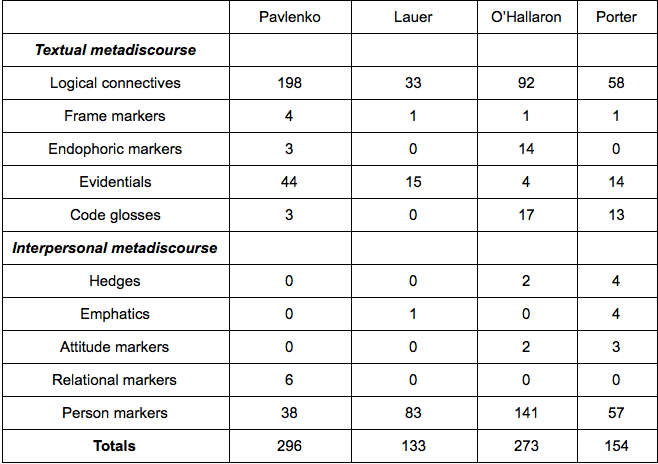
The articles were all different lengths so the overall number of metadiscourse forms were higher for some articles, but the percentages were similar amongst the four papers I examined. The two most popular single features were logical connectives and person markers, which surprisingly, were a subcategory from both textual and interpersonal forms. Other differences were a result of two of the articles being very heavily written in first-person. That put more weight towards the interpersonal forms and some of the results were skewed because of that. Pavlenko’s article in applied linguistics saw a total of 296 occurrences of metadiscourse use. Of the 296, 252 were textual forms and 44 interpersonal. 198 of the 296 were logical connectives, or 67 percent of all metadiscourse use. Some examples include:
“And thus provide the insider’s view of the processes…”
"Therefore, in addition to linguistic devices commonly..."
"... of a particular language memoir, but also its authorized..."
(Pavlenko, 2007)
Lauer’s paper on composition studies was a bit different. It was much shorter with only 133 metadiscourse features found. Where it differed from Pavlenko’s article was its heavy reliance on person markers, which accounted for 62 percent of all metadiscourse use. Other than that, the other uses were very similar with the other three. Lauer’s paper was more personal, she used her experience as evidence whereas Pavlenko’s relied on evidentials like “Victor Barnouw once remarked that from a scholarly perspective the...” and “Franceschini noted that her informant…” (Pavlenko, 2007) which referred to information from other texts to state the facts. Pavlenko didn’t immerse herself in the article—rather, she used other people’s insights to draw her conclusions. Aside from that, the metadiscourse use patterns aligns with what Hyland’s research stated. O’Hallaron et al, and Porter’s papers followed similar patterns to that of Pavlenko’s.
The biggest difference between Hyland’s findings and mine were that within English Studies, writers tended to put a lot of weight on “expressing explicit reference to authors” (Hyland, 1998). So writers in the English field felt the need to immerse themselves in their research, with the exception of Pavlenko. These examples will show writers referring to themselves:
“I was the only woman, but I felt no barriers” (Lauer, 1995).
“In our work, we have been introducing metalanguage from…” (O’Hallaron et. al, 2015).
“We might derive our own order from this scene” (Porter, 1986).
Person markers, like the ones shown above, help relay the importance of the writer’s contributions to the discipline they are writing in. The more they invest themselves into the paper, the more personal it becomes, which lends the research a certain variability.


Comments