#3 Conclusion
- wangmot

- Apr 23, 2019
- 2 min read
Updated: Apr 26, 2019
Here is the data from the four English research articles examined. The table shows the occurrences of each metadiscourse function.
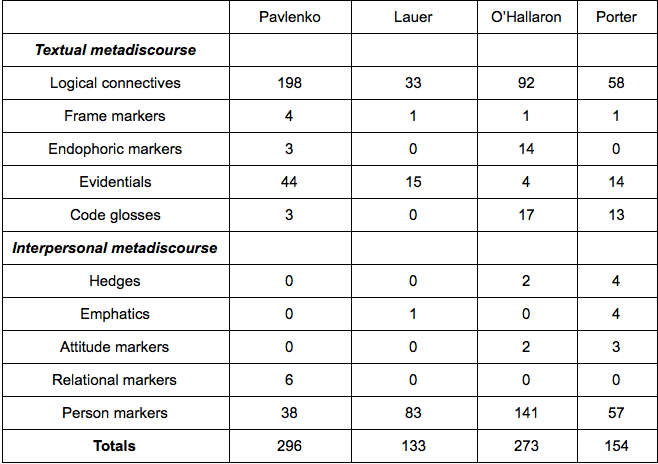
Compared to Hyland's research, the results were a little flipped. He found that interpersonal forms were more prevalent in the applied linguistics and marketing articles than in the STEM-related articles. Our study, contrarily, concluded that three of the four English articles were more textual than interpersonal. Alas, there isn't a conclusive finding here since all of the research articles in every discipline vary incredibly. Even within English, the results were across the map, albeit with some parallels. With a study like this where the POV an article is written in changes the dynamic of the paper incredibly, it is hard to conclude that humanities-based research articles are always more partial to interpersonal forms of metadiscourse than textual.
If we see an astrophysics research article written in first person POV, then it will surely be heavy on the interpersonal forms. If changes like that are studied, then it would be hard to get an exact consensus. Hyland's and my findings should be taken with a grain of salt, considering the results are based off the specific articles we chose. Had we chosen different articles from each discipline, the results would vary in a significant way. Thank you.
Works Cited
Dudley-Evans, Tony. “Variations in the Discourse Patterns Favoured by Different Disciplines
and Their Pedagogical Implications.” Academic Listening, pp. 146–158.,
doi:10.1017/cbo9781139524612.012.
Hyland, Ken. “Persuasion and Context: The Pragmatics of Academic Metadiscourse.”
Journal of Pragmatics, vol. 30, no. 4, 1998, pp. 437–455., doi:10.1016/s0378-
2166(98)00009-5.
Lauer, Janice M. “The Feminization of Rhetoric and Composition Studies?1.” Rhetoric
Review, vol. 13, no. 2, 1995, pp. 276–286., doi:10.1080/07350199509359187.
O’Hallaron, Catherine L., et al. “Reading Science: Using Systemic Functional Linguistics to
Support Critical Language Awareness.” Linguistics and Education, vol. 32, 2015, pp. 55–
67., doi:10.1016/j.linged.2015.02.002.
Pavlenko, A. “Autobiographic Narratives as Data in Applied Linguistics.” Applied Linguistics,
vol. 28, no. 2, 2007, pp. 163–188., doi:10.1093/applin/amm008
Porter, James E. “Intertextuality and the Discourse Community.” Rhetoric Review, vol. 5, no.
1, 1986, pp. 34–47., doi:10.1080/07350198609359131.


Comments